Starting an aquarium: the 7 mistakes to avoid for a successful setup
Do you want to start an aquarium under the best conditions? Discover the 7 most common mistakes and the essential tips for creating a balanced, healthy and lasting ecosystem.
Starting an aquarium: the 7 mistakes to avoid for a successful setup
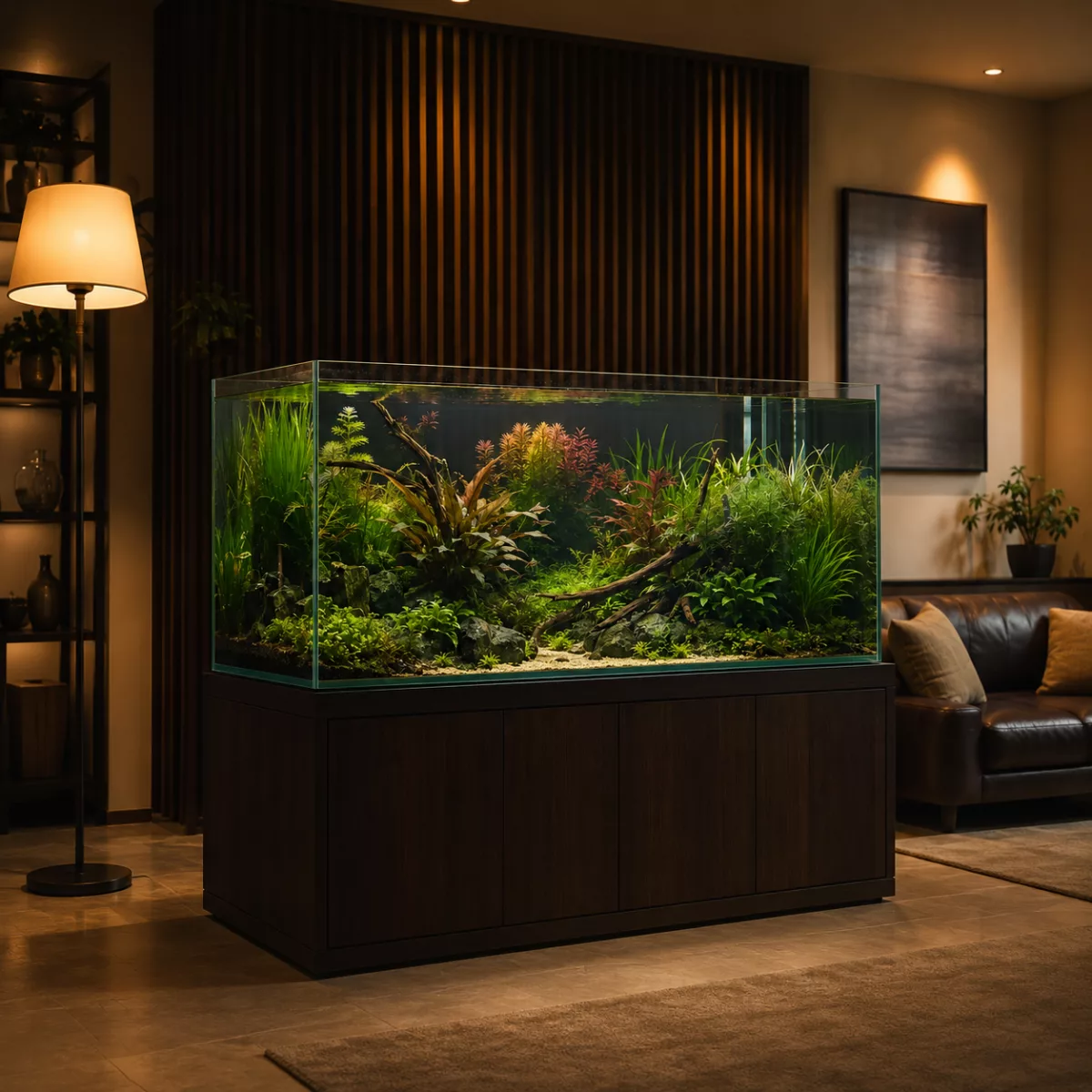
Setting up an aquarium is an exciting adventure. Choosing the tank, arranging the décor, installing the plants and imagining the future inhabitants are particularly thrilling moments. Yet behind the beauty of an aquarium lies a living ecosystem whose balance requires a little patience and understanding.
Most of the problems encountered during the first weeks do not come from a lack of goodwill, but from a few very common mistakes. Cloudy water, the appearance of algae, plants that wither, stressed fish or a rise in nitrites can often be avoided with suitable preparation.
Here are the seven main mistakes to avoid so that you can start your aquarium under the best conditions.
1. Choosing an aquarium that is too small
A small aquarium may seem simpler, less expensive and easier to maintain. In reality, the smaller the volume of water, the more quickly its balance can vary.
A small amount of excess food, a sick fish, a high temperature or postponed maintenance can quickly alter water quality. In a larger aquarium, these changes are generally more gradual and therefore easier to control.
Before choosing your aquarium, take into account:
the available space,
the adult size of the desired fish,
their behaviour and their need for space,
the number of individuals required for their well-being,
the needs in terms of filtration, lighting and maintenance,
The choice of volume must always be adapted to the future inhabitants of the aquarium, and not only to the space available in the room.
2. Introducing the fish too quickly
Once the aquarium is filled and set up with water, it is tempting to introduce the first fish immediately. However, clear water is not necessarily water that is biologically ready to receive them.
During start-up, the aquarium must establish its nitrogen cycle. Beneficial bacteria will gradually colonise the filter, the substrate, the décor and the various surfaces of the tank. They make it possible to transform the waste produced by the fish, the food leftovers and the organic matter.
During this process, toxic substances may appear, in particular ammonia and nitrites. Nitrites are particularly dangerous for fish, even at low concentrations.
There is no perfectly identical duration for all aquariums. The tank is ready when the measurements confirm that the nitrites have returned to zero and that the biological cycle is working correctly. Testing the water is therefore far more reliable than simply counting the number of days that have passed.
Patience during this stage is one of the best forms of protection for your future animals.
3. Choosing insufficient or unsuitable filtration
The filter is often regarded as a device serving only to retain visible waste. Its role is however far more important.
Effective filtration performs three main functions:
mechanical filtration, which retains particles and waste,
biological filtration, which houses the bacteria useful to the nitrogen cycle,
water circulation, which distributes oxygen, heat and nutrients throughout the aquarium.
The filter must be chosen according to the volume of the tank, but also according to its population. A heavily planted aquarium with a few small fish will not have the same needs as a tank housing large, particularly polluting species.
It is also necessary to avoid cleaning all the filter media completely at the same time. Cleaning that is too aggressive can eliminate a large part of the useful bacteria and weaken the biological balance. The foams and biological media should be maintained gradually, preferably with water removed from the aquarium during the water change.
4. Adding too many fish at once
Even when the nitrogen cycle is established, the biological balance of a new aquarium is still young. Introducing a large population all at once abruptly increases the amount of waste to be processed.
The bacteria present in the filter may then not be numerous enough to absorb this new biological load. This can cause an increase in ammonia or nitrites.
It is preferable to introduce the fish gradually, starting with the species best suited to the configuration of the tank. Between each introduction, observe the behaviour of the animals carefully and check the water parameters.
Before any purchase, also find out about:
the adult size of the species,
its territorial or peaceful temperament,
its need to live alone, in a pair or in a group,
the water parameters it requires,
its compatibility with the other inhabitants.
An aquarium should not be stocked according to a simple mathematical rule. Each species has specific needs that must be respected.
5. Lighting for too long from the start
Lighting is essential for plants, but an excessive duration will not necessarily make them grow faster. During the first weeks, the plants still have to take root and adapt to their new environment. Algae can then take advantage of an excess of light more quickly.
For a new planted aquarium, it is often preferable to start with a moderate duration, then to increase it gradually according to the reaction of the plants and the possible appearance of algae.
The power of the lighting must also correspond to:
the depth of the aquarium,
the plant species chosen,
the presence or absence of a CO₂ injection,
the quantity of nutrients available.
Light, CO₂ and nutrients must remain balanced. Greatly increasing one of these elements without adapting the others can encourage imbalances.
6. Adding products without measuring the water
Fertilisers, conditioners, bacteria, mineral salts and parameter correctors can be very useful when they meet a real need. However, adding several products without knowing the water parameters can create more problems than it solves.
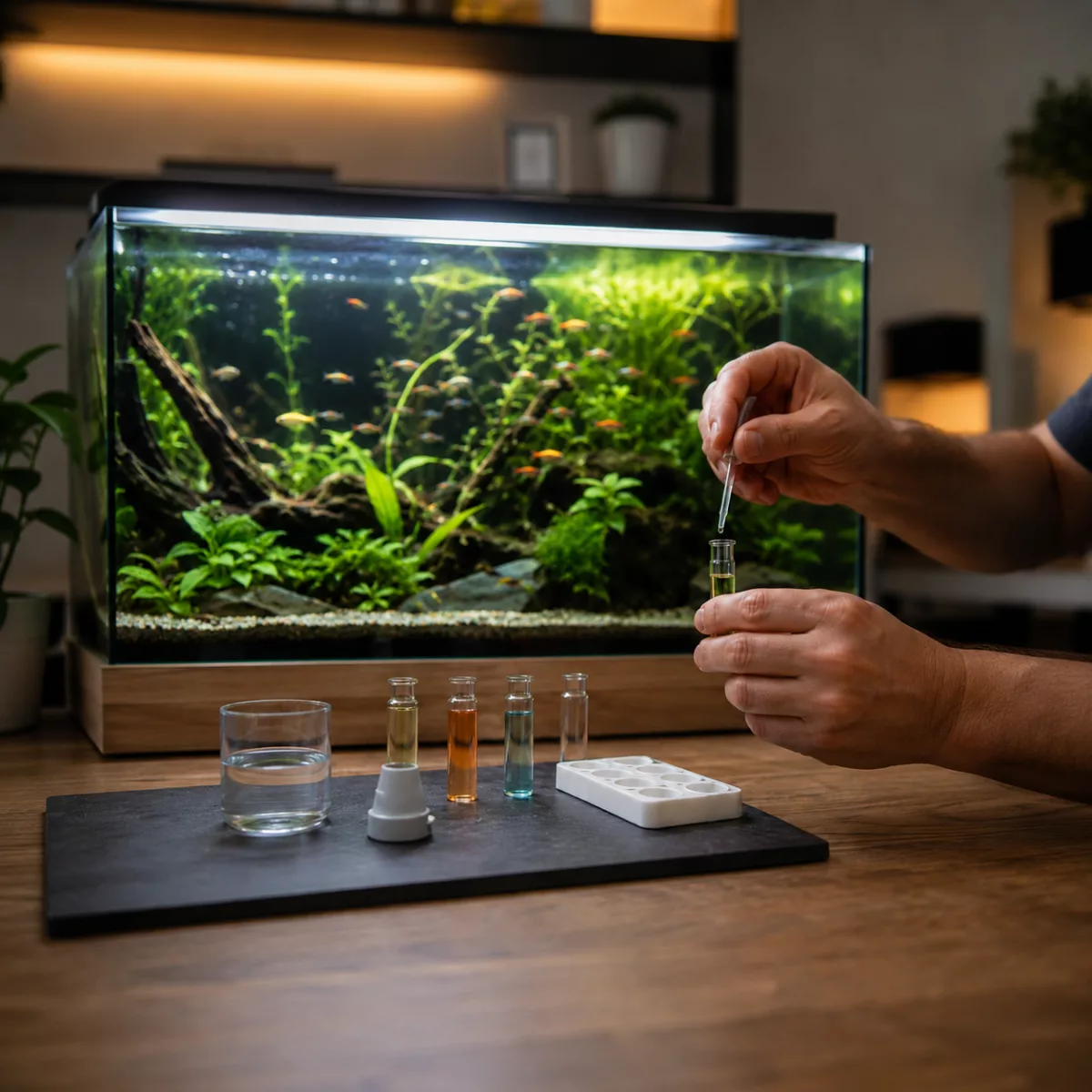
Before seeking to modify the water, it is important to measure and understand the main parameters in order to know their role and their effect in the water:
- the pH,
- the GH, which represents the total hardness,
- the KH, which contributes to the stability of the pH,
- the nitrites, or NO₂,
- the nitrates, or NO₃,
- the phosphates, or PO₄, particularly in a planted aquarium.
- then come other nutrients and parameters to take into account, such as iron.
The results must then be interpreted according to the fish, shrimp and plants present in the tank. A value is not universally good or bad: above all, it must be adapted to the needs of the species kept.
In aquarium keeping, measuring before adding allows you to act precisely and to avoid overdoses.
7. Cleaning the aquarium too much
A healthy aquarium is not a sterile environment. The bacteria, the biofilm and the micro-organisms play an essential role in its balance.
Cleaning the filter completely, replacing all the filter media, deeply vacuuming the entire substrate and carrying out a very large water change on the same day can abruptly disturb this balance.
Maintenance must remain regular, but gradual. It consists in particular of:
removing dead leaves and visible waste,
cleaning the glass when necessary,
carrying out suitable water changes,
maintaining the filter media without cleaning everything simultaneously,
regularly checking the water parameters,
observing the fish and plants daily.
A slight presence of algae or micro-organisms is not automatically a sign of a poorly maintained aquarium. The goal is not to obtain a sterile environment, but a stable and living ecosystem.
Good habits for a successful aquarium
To give yourself the best chances, keep in mind these few essential principles:
choose the volume of the aquarium according to the species desired,
install suitable filtration,
let the nitrogen cycle become established before introducing the animals,
test the water regularly,
introduce the inhabitants gradually,
adapt the lighting to the needs of the plants,
feed in moderation,
favour regular maintenance rather than a complete and abrupt cleaning,
take the time to observe your aquarium.
Observation remains one of the best tools of the aquarist. A change in the behaviour of the fish, a plant turning yellow or the sudden appearance of algae are often the first signs that an element deserves your attention.
Understanding balance rather than seeking perfection
An aquarium is constantly evolving. The plants grow, the fish produce waste, the bacteria develop and the water parameters can vary slightly. It is therefore entirely normal to have to make a few adjustments over time.
At Alchimia Aquatics, we are convinced that a successful aquarium rests above all on understanding its balance and on the alchemy between all the elements that compose it. Our objective is not limited to offering you equipment: we also wish to advise you and support you in creating a genuine aquatic ecosystem, harmonious and lasting.
Take the time to observe your aquarium and to understand it. And above all, do not hesitate to ask us your questions:
we are here to advise you and to help you find solutions suited to your setup.
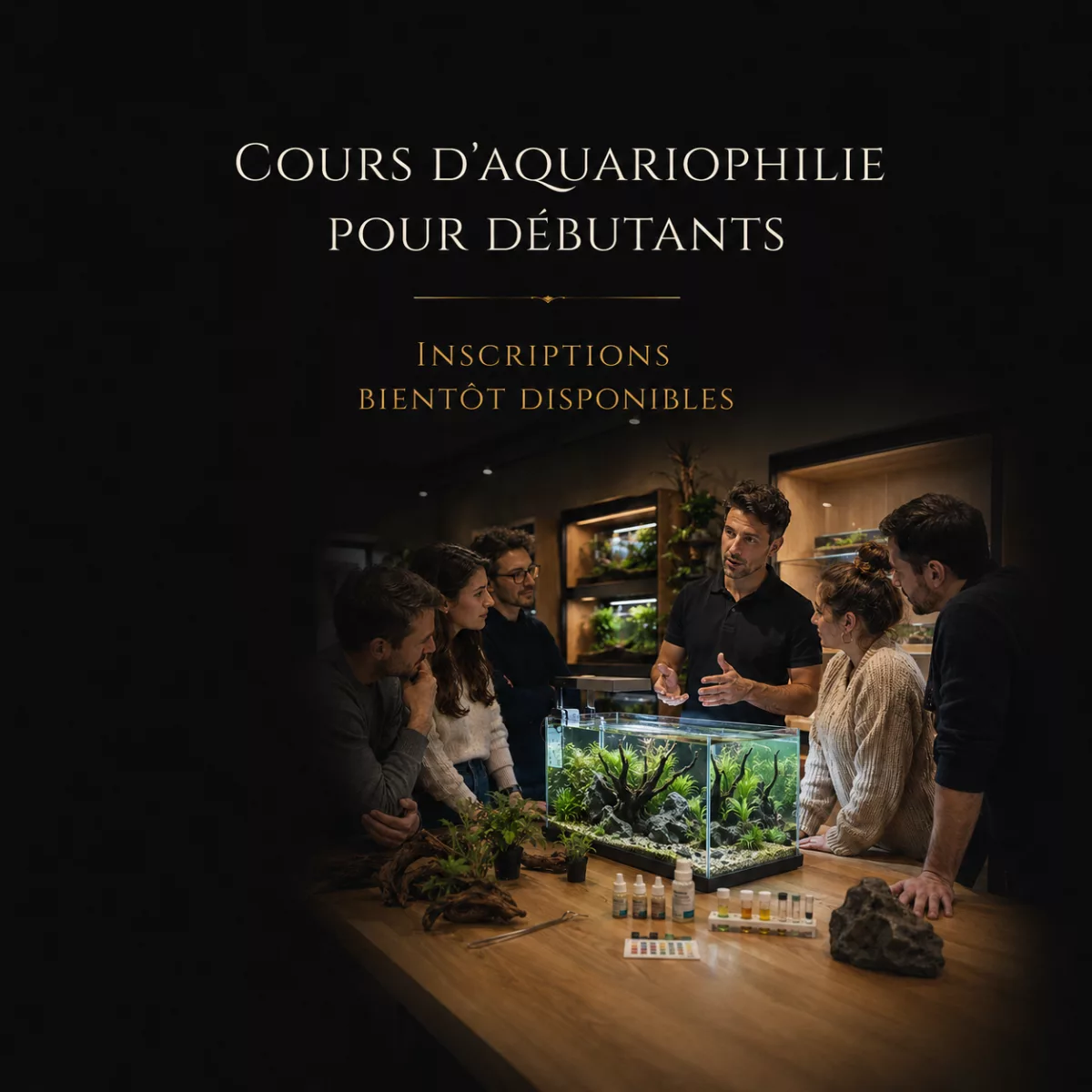
To support you even further, Alchimia Aquatics will soon offer training evenings devoted to starting up and maintaining an aquarium. There you will be able to learn, step by step, how to prepare your setup, choose the right equipment, understand the nitrogen cycle, correctly analyse the first water parameters and thus avoid the most common mistakes.
The dates and registration details will soon be available. Stay tuned: we cannot wait to share with you our passion and our experience in aquarium keeping.